1 m³ bulk bag, spouts top and bottom
A$900 + GST, ex factory. No minimum.
The Black Stuff is a humate soil conditioner mined on the Atherton Tablelands. The supplier's claim is short: it holds water and holds your fertiliser in the root zone, and in trial soils it was found still present and active five years after a single application.
Request a quote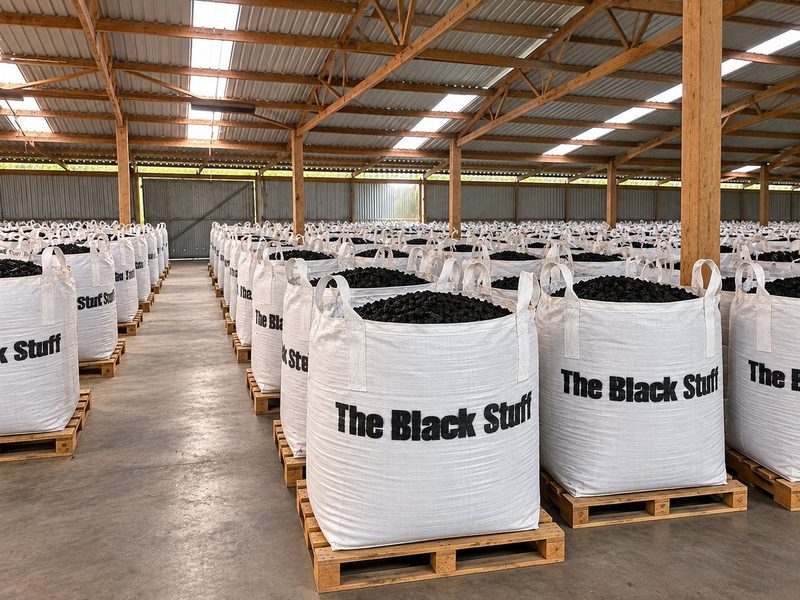
Supplier's typical analysis, Section A material. Varies by batch.
In plain words
Peat humate from a volcanic lake bed about 12 km south-east of Malanda. Plant material that settled under still water over tens of thousands of years. It is mined, screened and bagged. Screening is the only processing. It is not leonardite and it is not coal-derived.
It is a soil conditioner. It is not a fertiliser and it is not a registered agricultural chemical product. Nothing on this page is a claim that it controls, prevents or treats any plant disease.
Supplier's typical analysis: humic acid 11.3% average (IHSS method), fulvic acid 0.27 to 4.8%, organic matter 46.0 to 64.2%, pH about 4.5, conductivity 0.11 to 0.23 dS/m. Analysis varies between batches; the batch is on the docket or the pack.
How to use
The supplier's four steps:
These are starting points. Adjust with local agronomic advice and a current soil test. For a crop not listed, talk to us about rates for your crop.
Straight talk
Nothing in the first few weeks. It works on the soil, not the leaf. Judge it over seasons against your untreated strip. One 1 m³ bag treats about a third of a hectare, which is enough for that strip.
From the paddock
Growers' own observations on their own blocks, published by the supplier. Not replicated trials.
Custard apples, Mareeba confirm with Peter: name as on the supplier's page, John Jennings. 300 trees planted 2020 and 150 more in 2023. 2 m³ applied July 2025 to the original 300. March 2026: "The TBS-applied plants are a strong green while the untreated plants are pale and anaemic."
Lemons and limes, Dimbulah confirm with Peter: Oscar Bugno. Lemons on 4 ha, limes on 1.2 ha, sandy soil. Seven cubic metres applied in 2022. "With TBS the trees are a dark green."
Limes, Mareeba confirm with Peter: John Jennings. Nine rows over 1.6 ha, planted 2006 on sandy soil. One row treated in 2018, the whole block in 2019. confirm with Reece: his fruit-set quote is on the supplier's site; held here
Native fruit, Marian confirm with Peter: Simon Mattsson, a qualified agronomist. 600 trees planted 2021 on treated soils: lilli pilli, Davidson plum, tamarind, lemon aspen. "The lilli pilli is doing particularly well." The supplier adds that the observation is establishment, not yield.
Taro, O'Briens Hill confirm with Peter: Manou Vue, Fresh Touch. Applied at planting alongside dolomite lime, gypsum and a balanced NPKS fertiliser. "The difference was noticeable." One season, one block, no formal control.
Cavendish bananas, Wangan confirm with Peter: Tou Lee, Lee Agriculture. Added at planting in 2025. "Plants are healthy and have a good growth rate."
What it costs
A$900 + GST, ex factory. No minimum.
ask for a quote.
A$700 + GST a cubic metre, ex factory. About A$2,100 + GST a hectare at 3 m³, A$3,500 at 5 m³.
A$29.95 plus A$24.95 postage, anywhere in Australia.
confirm with Peter: bulk sizes and price
100 m³ and over is by negotiation. Prices are ex factory at Glen Allyn QLD; freight is quoted separately.
On the record
From 21 laboratory reports, 2004–2025, IHSS method.
| Humic acid | 11.3% (Section A average) to 32.3% (premium horizon) |
|---|---|
| Fulvic acid | 0.27–4.8% |
| Humin | about 62.9% |
| Total organic carbon | 27.0–37.8% |
| Organic matter | 46.0–64.2% |
| pH | 4.46–4.47 |
| Conductivity | 0.11–0.23 dS/m |
| N, P, K | very little |
| Arsenic (As) | <0.5 |
|---|---|
| Cadmium (Cd) | 0.10 |
| Chromium (Cr) | 12 |
| Copper (Cu) | 4.8 |
| Mercury (Hg) | 0.08 |
| Nickel (Ni) | 1.3 |
| Lead (Pb) | <0.5 |
| Zinc (Zn) | 12 |
Substantially below the EU 2019/1009 limits.
The Black Stuff is not a registered agricultural chemical. No claim is made that it controls, prevents or treats any plant disease.
Questions
No. It is a soil conditioner. Keep your lime, gypsum and fertiliser program. The supplier's taro account had it applied alongside all three.
The supplier reports it still present and active in trial soils five years after a single application. It is lost by being washed or blown off the area, which is why it is covered straight after spreading.
Expected. Look at the treated ground against your strip after a season.
It is acidic, about pH 4.5. Take a current soil test and your agronomist's advice before you settle on a rate. Do not change your water or fertiliser on the strength of it.
No. It is a solid. It is spread, covered and watered in. Fulvic Gold is the liquid extracted with water from the same peat, sold in 1 L bottles with garden and turf rates on its label. With any liquid, jar test first before it goes in a tank with something else.
No.
It is a soil conditioner. It is not registered as an agricultural chemical product and no disease claim is made for it.
Supplied moist it makes no dust. If it dries out it makes a fine dust: P2 mask, sealed goggles, gloves, long sleeves, and work upwind. Wash hands and face afterwards. The Safety Data Sheet (version 2.2, 31/08/2026) is linked below.
Prices are ex factory at Glen Allyn. Freight is quoted per order. The carrier does not unload, so you need a forklift or a loader with forks, firm ground and room to turn around. You can send your own carrier by arrangement. confirm with Peter: bag weight
Nothing is added to even it out, so colour and texture vary between batches. Recalibrate the spreader.
Quote