Growers with an EC meter: test a bottle and tell us your numbers.
Fulvic Gold is a liquid soil conditioner and carbon additive, extracted with water from one volcanic peat deposit in North Queensland. Nothing added. pH 6.8. We publish no EC figure yet, so we are asking the people who own the meters. Sample bottle and test sheet, no cost.
Apply for a sample bottle- Water-extracted
- Nothing added
- Wet Tropics NQ
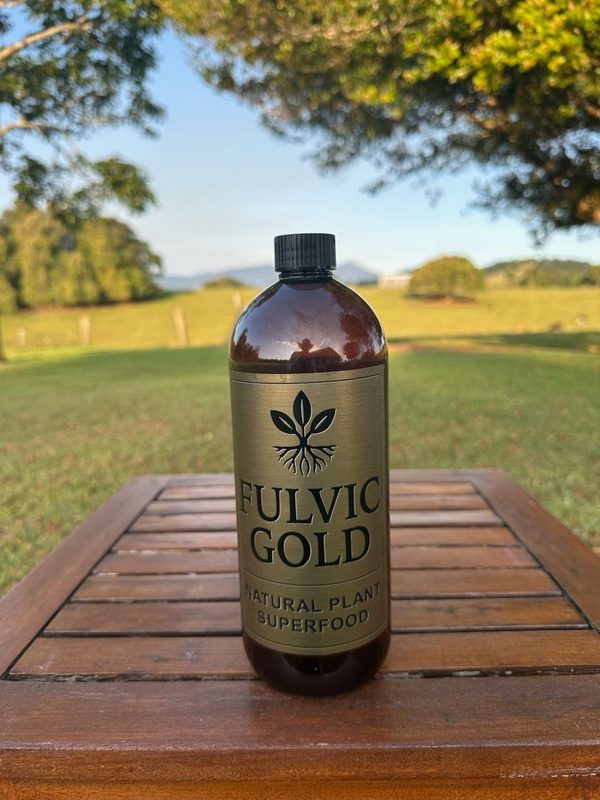
- 6.8pH
- Water-extractednothing added
- Analysisprinted on the label
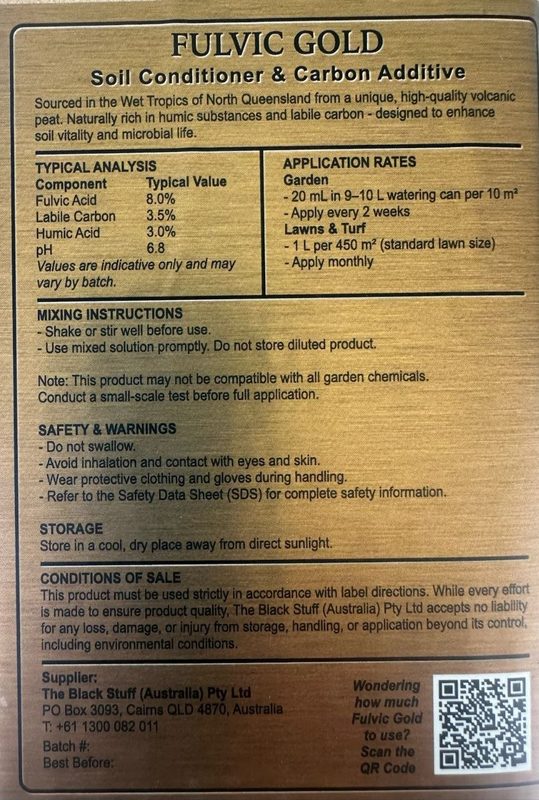
Fulvic acid 8.0%, humic acid 3.0%, labile carbon 3.5%. Typical analysis, indicative, varies by batch.
The test
How the test works
- We post you one 1 L bottle and a one-page test sheet. No cost. You keep the bottle.
- Crops for this round: tomatoes, chillies, lettuce, herbs or cucumbers, in coco, NFT, DWC, drip or ebb and flow.
- Dose: confirm with Peter: reservoir rate. The label gives garden rates only, so the rate for this test is written on your sheet. Do not exceed it.
- Before it goes near the main reservoir, mix a small jug with your usual nutrients and watch it for 30 minutes. It may not be compatible with every product in a feed line.
- You record: reservoir volume, dose in mL per litre, EC and pH before and 30 minutes after dosing, the daily drift, and a weekly dripper and filter check.
- You photograph: plants, roots where you can, reservoir, filter and one dripper, at weeks 2, 4 and 8.
- If you can run one reservoir or tray with it and one without, same feed and same crop, your numbers are worth twice as much.
- Shake before use. Gloves. Do not swallow. Keep it off skin and out of eyes.
- Shake or stir well before use.
- Use the mixed solution promptly. Do not store diluted product.
- May not be compatible with all garden chemicals. Test on a small area first.
- Avoid contact with eyes and skin. Wear gloves during handling.
- Store in a cool, dry place away from direct sunlight.
Garden
20 mL in a 9–10 L watering can, per 10 m²
Apply every 2 weeks
Lawns & turf
1 L per 450 m² (standard lawn size)
Apply monthly
Straight talk
What we know, and what we do not
What we know: it is extracted with water from volcanic peat and nothing is added. pH 6.8 from the bottle. The label analysis is fulvic acid 8.0%, humic acid 3.0%, labile carbon 3.5%, typical and indicative, varying by batch.
What we do not know yet: what it does to EC at a reservoir dose. How it behaves in drippers and filters over a full run. Whether it shifts pH drift at 5.8 to 6.2. What it does for a crop. We are not going to guess any of these.
What happens with your readings: we publish them, good or bad, with your first name and state or without, as you choose. Every tester gets the full set of results before they go public.
Typical analysis
Two ingredients. The numbers do the talking.
Typical analysis. Values are indicative only and may vary by batch.
The source
Tens of thousands of years in the making
Fulvic Gold is drawn from Lynch's Crater, a volcanic crater lake bed near Malanda on the Atherton Tablelands in North Queensland. Plant material built up there under standing water over tens of thousands of years, and became peat.
We extract it with water and add nothing. It is the same peat Queensland orchards spread on their citrus; ours is the water extract, bottled. That tells you where it comes from. It is not a promise about your garden.
Questions
Before you apply
Will it raise my EC?
We do not know yet, and that is the point of the test. We publish no EC figure for the concentrate or for a diluted mix. Measure before dosing and 30 minutes after, write both down, and tell us. confirm with Peter: EC of concentrate and of the test dilution
What rate do I use in a reservoir?
The label gives garden rates only: 20 mL in a 9–10 L watering can. The rate for this test is on your sheet. confirm with Peter: reservoir rate Do not go over it, and mix a small jug with your nutrients first.
Will it block my drippers or filters?
We have not tested it in drip lines, so check. The weekly dripper and filter check on the sheet is there for exactly this. If you see sediment, film or uneven flow, stop, photograph it and tell us.
How is it different from the fulvic additive I already buy?
We can only speak for ours. It is extracted with water from one volcanic peat deposit in North Queensland and nothing is added. We do not know how other brands make theirs and we will not guess. Run it beside what you use now and let your meter decide.
Results
Readings from the first testers
Sample request
Apply for a sample bottle
No price on this page
Nothing is sold here. One 1 L bottle and a one-page test sheet, posted to growers who will measure and share.
1300 082 011The Black Stuff (Australia) Pty Ltd